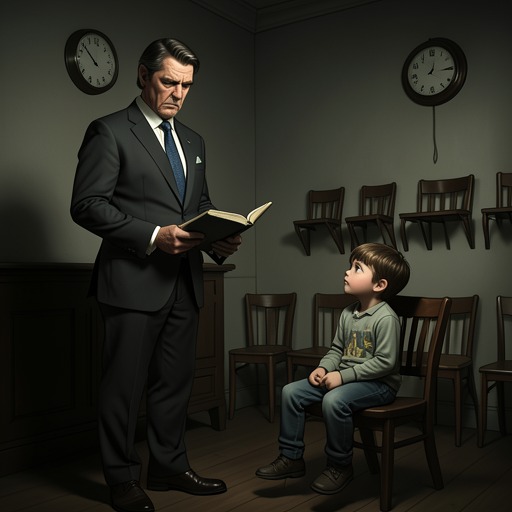
Three books pressed against the abdomen
The HousemaidThe Three books pressed against the abdomen are a set of textbooks that Andrew Winchester turns into instruments of confinement and punishment. First imposed on Millie Calloway while she is trapped in the attic, the books later become part of her retaliation against Andrew: the same physical arrangement that made her body submit is imposed on him in turn.
The Books and Their First Appearance
Millie finds the books on the floor of her attic room: A Guide to U.S. Prisons, The History of Torture, and a phone book. Their unexpected presence is unsettling, especially because her phone has also disappeared. Andrew later confirms that he left the books there, making clear that they were not incidental clutter but part of a demand he intends to enforce.
The selection gives the objects a pointed association with confinement and punishment. Two books explicitly concern prisons and torture; the third is an ordinary phone book, bulky and heavy. The set combines suggestive subject matter with practical weight. Andrew does not ask Millie to read them. He makes their mass, rather than their contents, the means by which he controls her body.
A Punishment Enforced Through Surveillance
Andrew orders Millie to lie on the floor and balance all three books on her stomach for three straight hours, promising to open the door afterward. She is locked in the attic room and, at first, treats compliance as a possible route out: if enduring the task gets her released, she can leave him. That calculation reflects the coercive terms of the scene. Andrew controls the door, the conditions of her confinement, and the prospect of release; the books give his command a concrete form.
The physical task escalates with each book. The prison guide is heavy, but initially manageable. The second book makes the pressure more uncomfortable against the hard, uncarpeted floor. The phone book is especially bulky and difficult to lift into place. With all three stacked on her abdomen, Millie struggles to breathe as the bottom book's edge presses against her rib cage. The order is not simply to hold a weight: she must maintain a vulnerable position under a load that becomes intolerable.
Andrew can monitor whether she obeys. When Millie questions how he could know if she lies, he reveals that he can see her through a hidden camera and says that he has been watching for weeks. The camera makes the books part of a wider system of control: even alone in the locked room, Millie is not beyond his reach. Andrew presents release as a favor he may grant, while insisting that she has no standing to make demands. The books therefore work alongside the lock and surveillance, converting his power over the room into a punishment she must physically perform.
Reversal and Retaliation
Later, Millie uses the same books against Andrew. She tells him that he will not leave the room until he has been punished for what he did to her, then directs him to lie on the floor and place the books on his abdomen. He initially treats the demand as ridiculous, but Millie maintains control of the door and the terms of release, reversing the arrangement that Andrew imposed on her.
The reversal is exact in its materials and posture, but not identical in bodily effect. Andrew is larger and stronger than Millie, and the books initially seem to cause him only mild discomfort. Millie then orders him to move them lower, onto his genitals. His expression changes to a grimace, and she tells him to remain that way for three hours. The available account establishes the command and the immediate reaction; its force lies in Millie's deliberate echo of Andrew's earlier punishment, not in any assumption about what happens over the full three hours.
Function and Significance
The books change meaning through repetition. In Andrew's hands, they make a locked room into a site where he can dictate how long Millie must lie still and what she must endure. In Millie's hands, the same objects let her reproduce his method and briefly occupy the position of the person setting the terms. Their weight is both literal and structural: the punishment depends on pressure against the body, while its repetition exposes the pattern behind Andrew's supposedly arbitrary demands.
The books also sharpen the contrast between the promise of release and the experience of captivity. Andrew offers to open the door after the task, but the offer does not make the punishment voluntary: he has confined Millie, removed her phone, and used a hidden camera to watch her. When Millie turns the books on him, she takes over the mechanics of that coercion. The objects are not simply a symbol of cruelty; their heft, edges, and placement determine what each person must physically endure, making the reversal immediate and legible.